

 All news

Building a four-legged options position by hand is where good ideas go to lose money. A client sketches an iron condor and enters the legs on the options chain one at a time. By the time the fourth order goes in, the underlying has ticked, and one leg has filled worse than planned. The net credit that justified the trade is already thinner. An options spread builder closes the gap between the net a client planned and the net they receive.
The builder treats the whole structure as one order. The client defines one combination, prices it as a package, submits it once, and tracks one ticket instead of four. DXtrade builds this around its Option Chain and its built-in option strategies. Before the order leaves the platform, DXtrade checks the legs against its structure rules and your risk limits. It also prices the package from the leg quotes and calculates margin on the position as a whole. Its pre-trade check models the ways the order can execute to find the worst case.
This article is for brokers weighing what an options trading platform should do with a spread order. It covers how your clients construct iron condors, butterflies, calendars, and verticals. It also covers what multi-leg options execution involves between the click and the fill.
Key takeaways
- An options spread builder sends a multi-leg strategy as one net-priced order, so leg risk has no point of entry.
- DXtrade’s built-in option strategies cover verticals, iron condors, butterflies, calendars, and other common structures, and clients can build custom spreads.
- Before routing, DXtrade checks each spread against its structure rules and your pre-trade risk limits.
- DXtrade sends the spread over FIX as one multi-leg order, and every fill carries all legs at the structure’s ratio.
- Under FINRA Rule 4210, an iron condor’s short options need no more margin than the width of the wider spread.
- DXtrade’s margin engine already applies FINRA’s intraday margin standards, which took effect on June 4, 2026.
- The Risk Profile shows break-even points and maximum profit and loss before the order goes out.
The cost of legging in
Legging in means entering each part of a spread as its own order and hoping the prices hold. Options quotes move with the underlying. The time between the first fill and the last is where leg risk lives. A client legging into an iron condor can end up holding the put side while the call side stays unfilled. That leaves them exposed to a directional move they never meant to take. If the short put fills before the long put that protects it, the exposure stops being defined at all.
The arithmetic of a spread relies on the net of what the client pays and what they collect. A position that costs more in premium than it brings in carries a net debit. One that brings in more than it costs carries a net credit. Entered leg by leg, a condor’s net depends on four independent fills. Entered as a package, it depends on one limit price the client sets for the whole combination.
A spread builder exists to protect that net. With it, your clients ask the market for a structure at a price. Without one, they assemble the structure themselves while the price drifts.
Building the structures your clients reach for
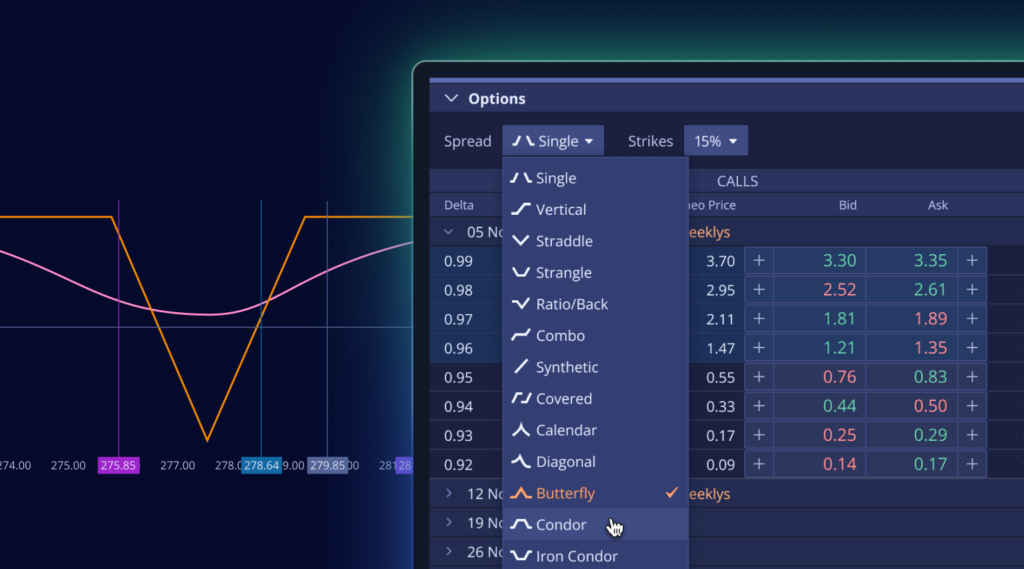
DXtrade includes preset templates for common options strategies. Among them are verticals, straddles, strangles, ratio spreads and backspreads, calendars, diagonals, butterflies, condors, and iron condors. A client picks a structure from the strategy selector, and the builder assembles the legs in the correct shape. For anything outside the templates, clients can build a custom spread.
Vertical spreads
Vertical spreads are the starting point. Each buys an option and sells another of the same type and expiration at a different strike. A debit spread pays premium for a move in one direction. A credit spread collects premium on the view that the underlying will not move past the short strike. Both fix the maximum gain and maximum loss at entry. The iron condor and the butterfly below each combine two verticals.
Iron condors
An iron condor combines two credit spreads on the same underlying and expiration. The put spread sits below the current price, and the call spread sits above it. The client keeps the full net credit if the underlying finishes between the short strikes at expiration. Its breakevens sit at the short put strike minus the credit and the short call strike plus the credit. The Options Industry Council’s strategy page gives the same breakevens. On an iron condor trading platform, four legs have to arrive together. That is where the builder earns its place. The client selects the iron condor template, chooses an expiration, sets the four strikes, and submits one order.
Butterflies
A butterfly concentrates a view on a single price. A long call butterfly buys one lower-strike call and one higher-strike call. It sells two calls at the middle strike, all in one expiration, for a net debit. Profit peaks when the underlying sits at the middle strike at expiration. The wings cap the loss on either side. A butterfly spread builder removes the fiddly part, which is the ratio. Two short contracts in the body for every long contract on a wing define the structure. A client who gets the count wrong by hand ends up holding a different position.
Calendar spreads
A calendar spread trades time instead of direction. The client sells a near-term option and buys a longer-dated option of the same type at the same strike. The client expects the near leg to lose value faster than the far one. Built this way, the position always costs a net debit to open. Calendar spread execution as a single order caps that debit at the client’s limit. It also keeps the short near-term option from filling without the longer-dated one that covers it.
What the platform validates before routing
Each options strategy template encodes the shape of its structure, including which legs the client buys and sells and in what ratio. In a vertical, the two legs share type and expiration and differ in strike and side. A calendar holds the strike constant and splits the expirations. A butterfly fixes its leg ratio at 1:2:1. An iron condor places both put strikes below both call strikes.
Structure also determines the margin a position carries. FINRA Rule 4210 treats long and short options as a spread when together they have a limited risk/reward profile. They must also meet five conditions. All options need the same underlying and the same exercise style, and they must be all listed or all OTC. On each option type, the long and short sides must cover equal aggregate underlying value. Finally, the short options must expire on or before the long ones. The last two depend on how the client puts the legs together. A calendar that sells the near-term option and buys the longer-dated one qualifies. A reverse calendar, which sells the longer-dated option, does not.
Leg validation then checks every spread before it routes. DXtrade accepts the order only when all option legs share one underlying and no instrument appears twice. It also checks the net price against the legs’ price increments. Your pre-trade risk limits apply as well. Quantity and position limits check each opening leg separately. Order value limits, by contrast, use the estimated cost of the whole spread. By default, a breach rejects the order, and you can switch a limit to manual review or an alert instead.
A malformed or over-limit order stops on the platform instead of reaching the executing destination. As a result, your operations team handles fewer downstream rejections and unwinds fewer unintended positions.
How a multi-leg order fills
Once the combination passes validation, the question becomes price. DXtrade’s order routing sends the spread over FIX to the executing destination as one multi-leg order. The order carries a single net limit. For a debit, it caps what the client pays; for a credit, it sets the minimum they accept. This is the core of fill logic for multi-leg orders.
Pricing the package
The package takes its price from its legs. DXtrade calculates the spread’s bid and ask from the leg quotes, weighting each leg by its ratio and contract multiplier. It rounds both to a tick size based on the legs’ own price increments. The mid-price between that bid and ask gives the client a reference point for the limit.
Clients choose the order type and net price to suit the moment. A marketable limit works when they want the fill now. A resting limit waits for the market to come to it. Multi-leg trades can also carry stop-loss and take-profit protection.
What happens at the exchange
Exchanges that run a complex order book treat a multi-leg order there as a single order. On Cboe Options, an eligible customer complex order that is marketable or near-marketable starts a 100-millisecond Complex Order Auction. The auction seeks price improvement for the order. Whatever does not trade in the auction rests on the Complex Order Book. Cboe also derives a National Spread Market from the NBBO of the individual legs. That figure serves as the reference price for its spread order protections.
A complex order can still receive a partial fill. An order for ten condors can trade four, with six left working. What the package prevents is imbalance. Every filled unit carries all four legs at the structure’s ratio. So the client never holds two legs of a trade whose other two never arrived. The leg risk that legging in creates has no point of entry. Fill quality also stops depending on how quickly someone can click through four tickets.
For your back office, each spread fill posts one cash amount for the whole structure. It also updates the position in each leg’s instrument.
Margin that reflects defined risk
A defined-risk spread caps its own loss by design. The capital held against it should reflect that cap instead of the gross exposure of each leg counted alone. Margin netting for options is how a platform makes the requirement match the risk.
Spread margin under Rule 4210
Rule 4210 sets the method for accounts at FINRA member firms. For a qualifying spread, the requirement on the short options is the lesser of two amounts. One is the standard short-option margin. The other is the spread’s maximum potential loss. The rule finds it by netting the legs’ intrinsic values at every strike in the structure.
For an iron condor, the rule’s maximum potential loss equals the width of the wider spread. That is because the underlying cannot finish below the put spread and above the call spread at once. The rule lets the premium collected count toward the requirement. So the cash the client puts up equals that width minus the net credit. That amount is also the trade’s maximum loss. Margined leg by leg, the same four options would tie up capital against both short options. Yet the two cannot both finish in the money.
DXtrade runs real-time margin calculations under FINRA rules before and after each trade. It also lets you configure house rules on top of the regulatory minimum. Rule 4210 expects that layer. It requires member firms to set their own margin requirements and to review when they need higher ones. Before an order routes, DXtrade also models the ways it can execute and finds the worst-case scenario. That way, the pre-trade check covers the least favorable outcome of the order. The platform supports both cash and margin accounts.
Intraday margin and single-order submission
Single-order submission also matters under the intraday margin standards that took effect on June 4, 2026. These standards replaced the pattern day trader framework. According to Regulatory Notice 26-10, a firm can treat the legs of a spread as simultaneous for intraday margin. That applies when the legs execute from a single order submission or otherwise substantially contemporaneously. A multi-leg order meets that test by the rule’s own wording. Legs entered as separate orders, however, depend on how close together they fill. When a firm cannot show which of two activities came first, it must assume the least favorable sequence. That means the sequence that produces the highest intraday margin deficit. Firms that need more time can phase in the new standards until October 20, 2027. DXtrade’s margin engine has already moved from day-trade counting to the new standards.
For your clients, a book of defined-risk spreads ties up capital in proportion to the risk they run. For your risk team, house rules apply before the order reaches the market.
Reading the trade before your clients place it
Construction and execution decide how a position enters the market. Whether a client should want the position at all is a separate question. DXtrade’s Risk Profile tool gives the client the numbers to answer it before the order goes out.
The tool runs what-if analysis on current or theoretical positions. It simulates changes in the underlying’s price and in volatility to give a time-based view of profit and loss. On the risk graph, the client reads the payoff curve directly. The curve shows where the break-even points fall and where maximum profit sits. It also shows where the maximum loss stops and how the position behaves between those bounds. At expiration, an iron condor’s curve shows its profit zone as a plateau between the short strikes. A butterfly’s curve peaks at the body strike and slopes down toward each wing.
Because the analysis runs across time and volatility scenarios, it shows how the position behaves before expiration. A static P&L diagram, by comparison, shows only the end state. A client who sees the break-even points and the volatility sensitivity before routing chooses size and strikes with fewer surprises. That client also sends a structure they already understand.
What an options spread builder means for your brokerage
A spread builder removes the failure points between a sound idea and a clean position. It assembles the legs, checks them before routing, sends one net-priced order, and calculates margin that matches the defined risk. Before the order goes out, the Risk Profile lets clients weigh the trade-offs in the structure.
For you as a broker, this is one part of a credible options trading platform. Our look at competing in options trading covers several of the others. A platform for spread traders has to keep the structure intact from the first click to the fill. It also has to show the risk before the client commits. You can read more about the Option Chain and the Risk Profile on the DXtrade platform page. To walk through multi-leg order handling for your setup, contact our team.
Frequently asked questions
What is an options spread builder?
An options spread builder is the part of an options trading platform that turns a multi-leg strategy into a single order. The client chooses a structure such as a vertical, calendar, butterfly, or iron condor and sets its strikes and expirations. The platform then submits all the legs together at one net price, so no leg fills without the others.
Does DXtrade have an options spread builder?
Yes. DXtrade’s built-in option strategies work as an options spread builder. Clients pick a preset structure from the strategy list or build a custom spread. DXtrade prices the spread from the leg quotes and validates the legs against its rules and your pre-trade risk limits. It then routes the spread over FIX as one multi-leg order.
